
May 2026: 🟡 Is it time to leave Mailchimp?
Is it time to leave Mailchimp following last week’s news?
No.
There you go. Saved you a scroll.
Last week’s big layoff news from Intuit
Last week Intuit suddenly announced it was making 3,000 redundancies across their various brands: Quickbooks, Mailchimp, TurboTax and Credit Karma. The reason given was to invest more in AI. Obviously a whole other can of worms and a topic for another day.
There’s been a LOT of talk about it - noise, theories, dramatic press releases and opinions.
Mailchimp has been identified as the slightly less profitable arm of the Intuit group (although still profitable). So they made some business decisions which feel painful and have affected a lot of talented, kind, intelligent and wonderful people. I know a lot of people personally affected by the layoffs - either they’ve been made redundant or they’re still there but dealing with the emotions and uncertainty. I’m truly gutted for them. It also means this is a brilliant time to be hiring talent because there’s a lot looking right now.
But for Mailchimp users, this is business as usual.
Given the recent news around Intuit layoffs and Mailchimp, I suspect we’re about to see a fair bit of noise from other email platforms.
Some of it will be useful comparison content. A lot of it will be the usual SaaS (Software as a Service) shark behaviour, circling the waters with a “time to migrate?” message before most people have even worked out what if anything has changed.
To put it into perspective, other well-known tech companies have also made layoffs this year - including Salesforce, Oracle, Atlassian, Wix, Meta, Standard Chartered, Freshworks… (It’s a shit time to work in tech by the looks of it.)
What if anything should you do?
Here’s my calm, boring, deeply practical take as someone who has worked with Mailchimp for years…
I’ve been a Mailchimp Partner and Pro Partner for YEARS.
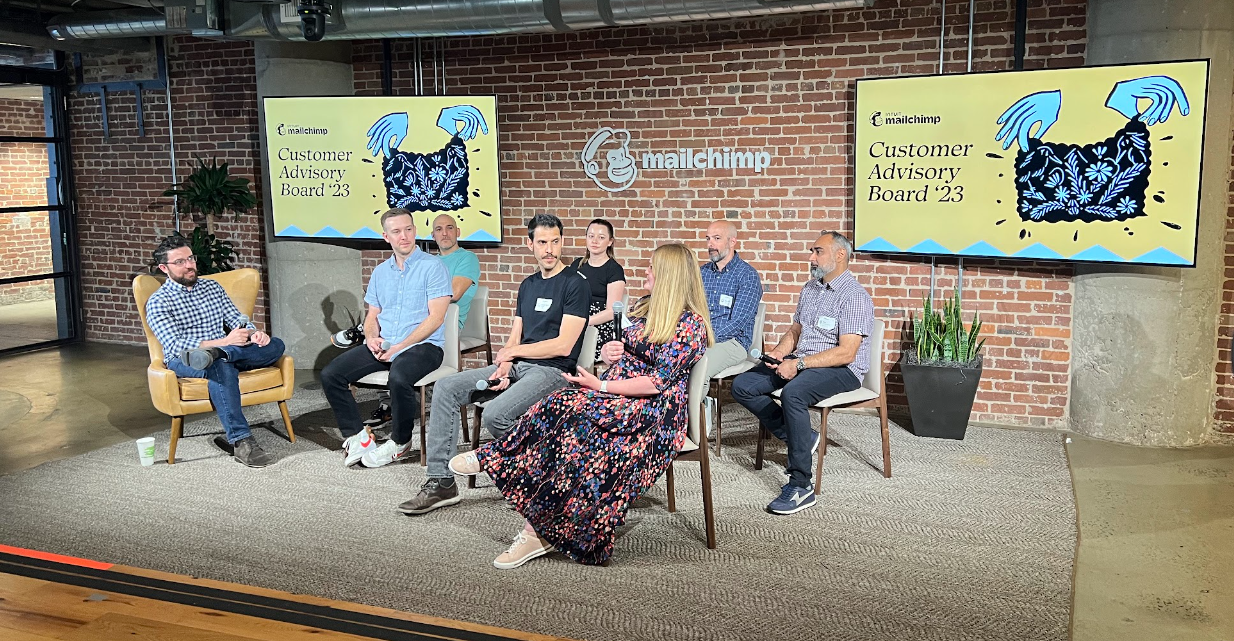
As part of that, it means I’ve worked closely with a lot of the people IN Mailchimp, from leadership to software engineers to partner success managers. I’ve been on their Customer Advisory Board working, flying over to Atlanta to work with them together. We’ve hung out together, chatted over coffee, breakfast, lunch, dinner and cocktails. Collaborated on events together. Laughed and sworn together. Figured out issues together. Picked each other’s brains. In short, we’ve got to know each other, become virtual colleagues, friends, and worked together to make Mailchimp as good as possible for you.
And throughout that time I’ve seen Mailchimp go through a lot of big changes, and come out the other side.
One of the biggest and most far reaching was when Inuit bought it a few years back - it moved from a quirky, experimental and slightly random “start-up” to a more corporate vibe, but with a market responsiveness that continues to make me happy (most of the time).
They’ve continued to invest in the product, and over the last few months in particular they have made lots of brilliant improvements and enhancements (in hindsight, probably before they laid off some of their software engineers).
What this means for you as a Mailchimp customer
Mailchimp is not disappearing.
Nothing has changed.
Your campaigns are not suddenly invalid.
Your automations do not need to be dragged into another platform because someone on LinkedIn has written a dramatic post.
You do not need to move because another email marketing platform is circling around trying to tap into the worry.
And moving from one email platform to another is not a small admin job. It is disruptive. It affects data, forms, integrations, automations, reporting, templates, permissions, compliance and all the little bits of logic people forget exist until something breaks.
So no, thankfully this news does not suddenly make migration necessary.
Could reduced investment affect future development for some businesses with very specific technical needs?
Possibly. If you are relying on very advanced custom integrations, enterprise-level roadmap requirements, or cutting-edge functionality, it is sensible to keep an eye on where the product goes next. In all reality, if that’s you, you were probably never with Mailchimp in the first place.
But for most small to medium businesses, charities, ecommerce brands and growing organisations using Mailchimp for email marketing, automations, forms, segmentation and integrations, the answer is much less dramatic:
Keep going. Business as usual.
Instead, continue focussing on making better use of what is already there:
Clean up your data.
Review your audiences, tags, groups and segments.
Check your forms and consent.
Continue to grow your mailing list.
Improve your automations.
Use the reporting properly.
Make sure Mailchimp is connected properly to the rest of your marketing and business systems.
Make sure you are using the latest templates and features.
Send emails and SMS with intention as part of your broader marketing strategy.
Because Mailchimp remains a strong, widely used product with a huge integration ecosystem. That matters. It is one of the reasons it continues to be a good choice for so many organisations.
I’ve seen a lot of Mailchimp changes over the years. Pricing changes. GDPR. Feature changes. Interface changes. Branding changes. AI. Fairly regular “where the hell have that moved x to now?” moments.
And yes, this is a significant moment for some people. But it is not a reason for you to panic or change.
My advice?
Ignore the noise. Avoid knee-jerk migrations. Beware anyone trying to turn uncertainty into a quick platform switch.
Instead, use this as a prompt to get your Mailchimp account working properly.
Because for most users, the best next move is not moving. It is making better use of the platform you already have.
Who even am I?
I’m Claire Witz, Chief Chimpologist at Chimpology, and I help organisations get more from Mailchimp without the drama. If you have questions or need help, get in touch.